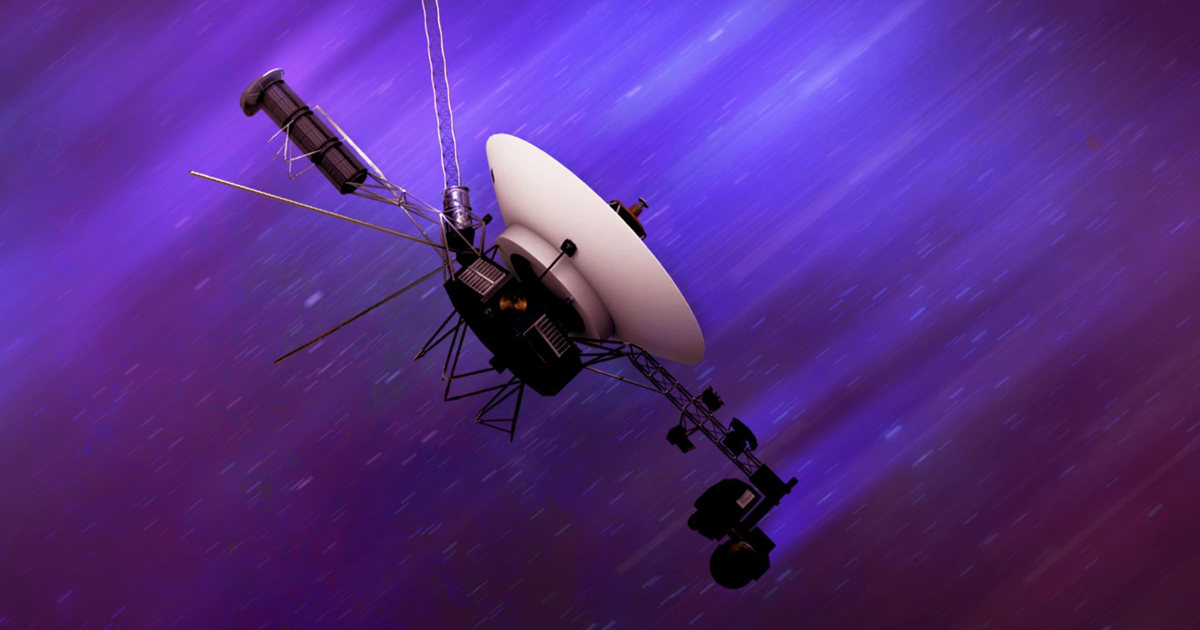
A 49-Year-Old Robot Is About to Be One Light-Day From Home
Save the date: November 18, 2026, just after midnight Central time. That's when NASA says Voyager 1 hits a milestone nothing built by humans has ever reached. It will be one light-day from Earth.
Wait, what's a light-day?
It's a distance. Light is the fastest thing in the universe. It can lap the Earth about seven times in one second. A light-day is how far light travels in 24 hours, which works out to about 16.1 billion miles.
So when NASA sends Voyager 1 a message, it takes a full day to get there. The reply takes another day to get back. That’s fuckin nuts. I have no idea how we got something that deep in space but it’s pretty awesome.
This thing launched in 1977
Voyager 1 left Earth on September 5, 1977. Some of your parents might not have been born yet. On the way out it flew past Jupiter and Saturn and sent back some of the first close-up photos of them.
In 1990 it turned around and took the famous "Pale Blue Dot" photo: all of Earth, everyone who has ever lived, showing up as one tiny speck in a beam of sunlight. In 2012 it became the first spacecraft to leave the Sun's bubble and enter interstellar space.

It's still flying at about 38,000 miles per hour, and it's never stopping.
It runs on basically nothing
Here's the part that breaks my brain. Voyager 1's three computers have about 68 kilobytes of memory combined. One photo on your phone is probably more than 2,000 kilobytes. It sends data home at about 160 bits per second, which is way slower than the worst Wi-Fi you've ever experienced.
It's powered by heat from decaying plutonium, and that power gets weaker every year. NASA has been turning instruments off one by one to keep it alive. In late 2023, it suddenly started sending gibberish. Engineers spent five months working out that a single memory chip had failed, then reprogrammed a spacecraft billions of miles away to work around it.
It's carrying a mixtape
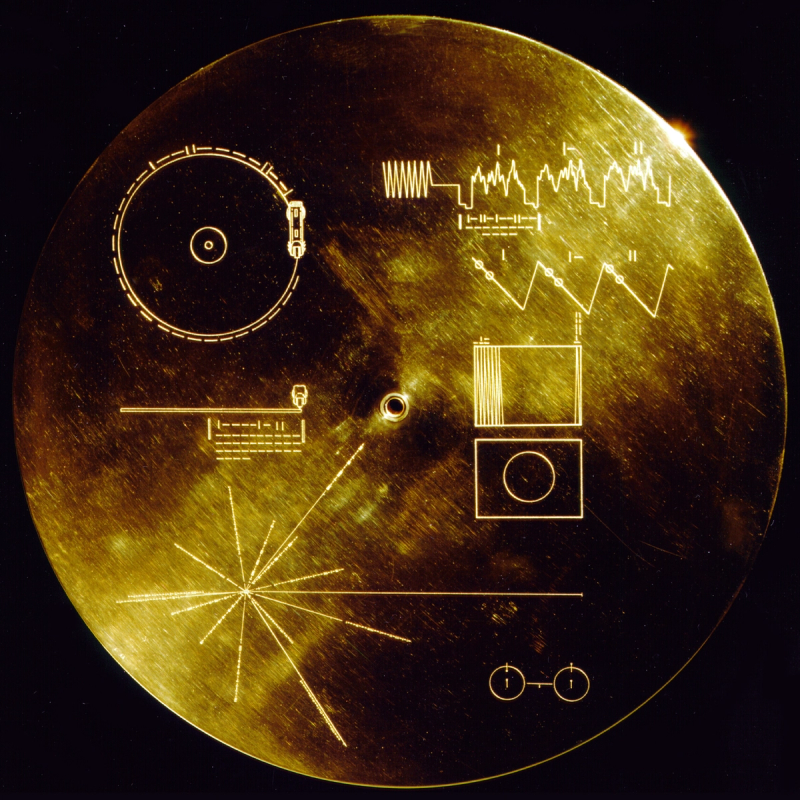
Voyager 1 has a gold record on board, in case aliens ever find it. It has greetings in 55 languages, 27 pieces of music, 116 pictures, and everyday sounds from Earth. The cover even has a map showing where our Sun is. It's basically humanity's "About me" page. Personally I think it’s hard for people to not to believe in aliens given the infinite universe. I would love if aliens found it but I think realistically they won’t.
How long does it have?
Not forever. Its power will run out sometime in the 2030s, and by around 2036 our antennas probably won't be able to hear it anymore. After that it keeps drifting through the galaxy in silence. My guess is that if aliens were to find it, it wold be long after we lose touch but hopefully the record stays in tact.
It won't come near another star for about 40,000 years. Even after 49 years of nonstop travel, it has covered less than 0.003% of the way to the nearest star. Space is big.
Why it matters
The people who built Voyager 1 used slide rules and computers weaker than a calculator. They planned a mission for about five years. It's still working almost half a century later, farther away than anything we've ever made. On November 18, take a second to look up. Somewhere out there, a little robot with a mixtape is one whole day away, still calling home.
Cover illustration: NASA/JPL-Caltech (public domain)